Ceremonial Grade Matcha: What the Label Really Means

You have seen the words on the tin: ceremonial grade matcha. It sounds like a seal of approval, something official, perhaps inspected by a stern Japanese tea master with a clipboard. The truth is rather less ceremonial. There is no government body, trade organisation or certification scheme that defines the term. Any brand can slap 'ceremonial grade' on the label regardless of quality, origin or production method. So how do you know if your matcha is actually any good? You look at how it was grown, harvested, processed and milled, then you taste it. That is what this guide is for.
The tea in this guide: Izu Matcha from £4.80 Shop it →
Ceremonial grade, when the term is used honestly, means matcha fine enough to drink whisked with water alone, without milk or sweetener to hide any flaws. It should be vivid green, smooth on the tongue, low in bitterness and rich in that savoury-sweet taste the Japanese call umami. If it tastes like lawn clippings steeped in disappointment, the label lied.
At a glance
- 'Ceremonial grade' is a marketing term, not a regulated standard
- Quality depends on shading (3 to 4 weeks), first-flush harvest, careful de-stemming and slow stone milling
- Good matcha is vivid jade green, not olive or yellowish
- Expect sweet, umami, low-bitterness flavour; if it is harsh, something went wrong
- Culinary matcha uses later harvests and faster milling; better for baking than drinking straight
- Price alone proves nothing; colour, aroma and taste tell the real story
Why 'ceremonial grade' is not what you think
The phrase began appearing in Western markets in the early 2000s, when matcha started showing up in health-food shops and premium tea aisles outside Japan. Sellers needed a way to distinguish powder meant for whisking from powder meant for muffins. 'Ceremonial' sounded suitably impressive, so it stuck.
In Japan, there is no universal ceremonial-grade category. Matcha may be described as suitable for koicha (thick tea) or usucha (thin tea), or graded by the producer according to cultivar, shading, processing and milling finesse. No organisation regulates the term, and Japan has no standardised matcha grading system. Only tencha, the raw leaf, has a regulated wholesale definition.
This does not mean all ceremonial matcha is a con. It means you cannot rely on the label. You have to look at what is actually in the tin.

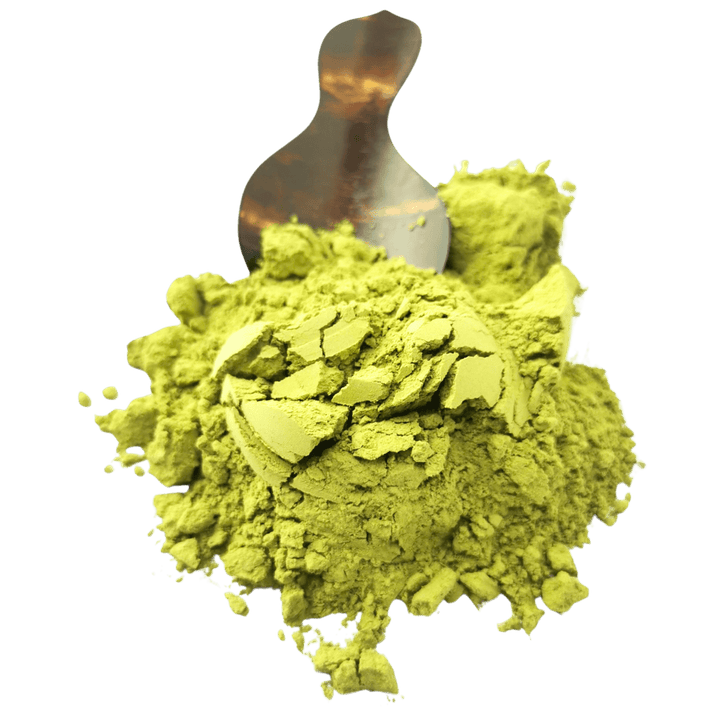
Matcha
Finely powdered green tea for whisking, iced drinks or a matcha latte. Sift first to keep things smooth.
Have a lookWhat actually makes matcha good?
Matcha quality comes down to a handful of variables. Get them right and you end up with something worth drinking. Get them wrong and you have expensive green dust.
Shading
Tea plants destined for matcha are covered for three to four weeks before harvest, blocking most sunlight. This stresses the plant in a useful way: chlorophyll levels rise (hence the vivid green), bitterness-causing catechins stay low, and L-theanine, the amino acid responsible for umami and that calm-alert feeling, builds up. Shading produces sweeter flavour, less bitterness and brighter colour. Top lots are shaded 20 to 30 days under built canopies of reed and straw; cheaper matcha may get a week under black cloth, or nothing at all.
Harvest
The first spring harvest, called ichibancha, uses the youngest, most tender leaves. This runs from early April in Kagoshima to early June farther north and is associated with higher L-theanine, sweeter flavour and the highest grades. Second-flush nibancha arrives in June or July, producing coarser, more astringent leaf better suited to cooking.

Processing
After picking, the leaves are steamed to halt oxidation, then dried. Unlike sencha or gyokuro, tencha is not rolled; it is laid flat, then separated from stems and veins before grinding. Stems and veins disrupt the mill and produce gritty, uneven powder. The more carefully they are removed, the smoother the final matcha.
Milling
Traditional granite stone mills, called ishi-usu, rotate at roughly 55 to 60 revolutions per minute and produce about 40 grams per hour. The slow speed keeps temperatures low, preserving colour and aroma, and achieves particles around 6 to 10 microns. Faster milling, such as steel-ball mills, can oxidise and burn the leaves, resulting in duller colour and less complex flavour. A fine grind mixes easily and froths well; a coarse grind clumps and sinks.
How to spot good matcha before you buy
Since the label cannot be trusted, here is what to look for instead.
| Indicator | Good sign | Warning sign |
|---|---|---|
| Colour | Vivid jade green | Olive, yellowish or brown |
| Aroma | Sweet, marine, 'shade aroma' | Stale, flat or fishy |
| Texture | Silky, ultra-fine powder | Grainy or gritty |
| Taste | Umami, low bitterness, sweet finish | Harsh, astringent, grassy |
| Origin info | Region, harvest, shading disclosed | Vague or missing |
Uji in Kyoto and Nishio in Aichi Prefecture are historically renowned matcha-producing areas. Shizuoka and Kagoshima also produce quality leaf. A seller who can tell you where the tea was grown, when it was harvested and how it was processed is usually a seller worth trusting.
Ceremonial vs culinary matcha: the real difference
If ceremonial matcha is meant for drinking straight, culinary matcha is meant for everything else: lattes, smoothies, cakes, ice cream. The two differ in harvest, processing and price.
| Aspect | Ceremonial (whisking grade) | Culinary (cooking grade) |
|---|---|---|
| Harvest | First flush, youngest leaves | Second, third or fourth flush |
| Shading | 20 to 30 days | Shorter or partial |
| Stem/vein removal | Strict | More included |
| Milling | Slow stone-ground | Faster machine-milled |
| Colour | Vivid jade | Yellowish or army green |
| Flavour | Umami, sweet, low bitterness | Bolder, more astringent |
| Best use | Whisked with water, simple lattes | Baking, smoothies, cooking |
| Typical price | £25 to £75 per 30 to 50 g | £10 to £25 per 30 to 50 g |
Using ceremonial matcha in a chocolate brownie is not a crime, but its delicate flavour may vanish. Using culinary matcha for a straight-up whisked bowl is a mistake: the bitterness will dominate. Match the grade to the task.
Common myths about matcha grades
'Ceremonial grade is certified'
No. There is no independent certification body. The term is marketing shorthand, not a legal standard.
'Bright green means it is fresh'
Colour indicates chlorophyll content, which comes from shading and first-flush harvest. A freshly milled batch of poorly shaded later-harvest matcha will still look dull. Colour is one clue among several, not proof of freshness.
'Japanese matcha is always better'
Most high-quality matcha is Japanese, but origin alone is not a guarantee. Poorly processed Japanese matcha exists, and good matcha is starting to appear from other countries. Ask about shading, harvest and milling, not just geography.
'More expensive always means better'
Price often tracks quality, but not always. Some brands charge a premium for pretty tins and wellness marketing. Taste it. If the £60 matcha tastes worse than the £30 one, trust your tongue.

How to prepare ceremonial matcha
The traditional method is simple, though it takes a little practice to get the froth right.
- Sift 2 g of matcha (about half a teaspoon) through a fine mesh into a dry bowl to break up clumps.
- Add 60 to 80 ml of water at 75 to 80 °C. Boiling water will scorch the tea and amplify bitterness.
- Whisk briskly with a bamboo whisk in a W or M motion until smooth and finely frothy, about 15 to 20 seconds.
- Drink immediately. Matcha settles quickly.
This is usucha, thin tea. For koicha, thick tea, you use about 4 g in 40 ml and stir rather than whisk, creating a syrupy paste. Koicha exposes any bitterness or lack of depth, so only genuinely excellent matcha can handle it.
If you are making a latte, whisk the matcha into a smaller amount of water first, then add steamed milk. A wide bowl makes the whisking easier, and the Yoko Traditional Matcha Set has bowl, whisk and scoop together if you are starting from scratch.
A little matcha history
Matcha's origins trace back to Tang Dynasty China, where tea was sometimes powdered and whisked. Buddhist monks brought the practice to Japan in the twelfth century, and it evolved into the formal tea ceremony, sadō or chadō, that persists today. Historic tea houses in Uji have long insisted that tencha quality matters more than milling method; stone milling cannot rescue poor leaf. That wisdom has not changed in centuries.
In Britain, matcha went from niche import to coffee-shop staple in about a decade. The green latte is now as common as the flat white, though the quality varies wildly. Knowing what makes good matcha helps you order well, make it better at home, and avoid the grey-green sludge that gives the whole category a bad name.
What to try next
Izu Matcha is our finely powdered green tea for whisking, iced drinks or lattes. It has a creamy mouthfeel and a grassy, savoury character that holds up well in milk. Sift it first to keep things smooth.
If you are new to matcha and want the tools as well as the powder, the Yoko Traditional Matcha Set includes a bowl, whisk and scoop. For a broader look at Japanese teas, the Japanese Green Tea Adventure Box lets you compare sencha, genmaicha, hojicha and more side by side.
Not sure where to start? The Tea Finder quiz asks a few quick questions and points you somewhere sensible.

Teaware
A matcha bowl, bamboo whisk and scoop together in one set. Bring the matcha; the tools are here.
Have a lookOrders over £35 ship free anywhere in the UK, and we pack orders by hand in Huddersfield. If you are ever in Huddersfield, the shop is in Byram Arcade. The kettle is usually on.
Frequently asked questions
What is ceremonial grade matcha?
Ceremonial grade matcha is, in theory, matcha high enough in quality to drink whisked with water alone, without milk or sweetener. However, the term is not regulated or certified by any official body. It is a marketing label, not a guarantee. To judge quality, look at colour, aroma, texture and taste, and ask about shading, harvest and milling.
What is the difference between ceremonial and culinary matcha?
Ceremonial matcha uses first-flush, shade-grown leaves that are stone-milled into ultra-fine powder. It tastes sweet, umami-rich and low in bitterness. Culinary matcha uses later harvests and faster milling, producing bolder, more astringent powder better suited to baking, smoothies and cooking rather than drinking straight.
What is the best matcha in the UK?
The best matcha is vivid jade green, silky in texture, sweet and umami-forward with minimal bitterness. Look for sellers who disclose origin, harvest season and processing details. Avoid vague labels and wellness hype. Taste a small amount before committing to a large pack.
How can I tell if matcha is good quality?
Check the colour: it should be vivid green, not olive or yellow. Smell it: good matcha has a sweet, marine aroma. Feel it: the powder should be silky, not gritty. Taste it straight: it should be umami-rich with low bitterness. If any of these fail, the quality is suspect.
Does matcha contain caffeine?
Yes. Matcha is powdered green tea, so you consume the whole leaf and its caffeine. A typical 2 g serving contains roughly 70 mg of caffeine, compared to 95 to 200 mg in an 8 oz cup of drip coffee. L-theanine in the tea may moderate how the caffeine feels, but matcha is not a caffeine-free drink.
How do I store matcha?
Keep matcha sealed, away from heat, light, moisture and strong aromas. A cool, dark cupboard is fine; the fridge works if the tin is airtight. Once opened, use it within a few weeks for best colour and flavour. Do not leave an open tin on the counter all day.